Septic Tank Pumping in League City, TX
Septic tank pumping service in League City, TX. We measure sludge, empty both compartments, and set a realistic pumping interval for your household.
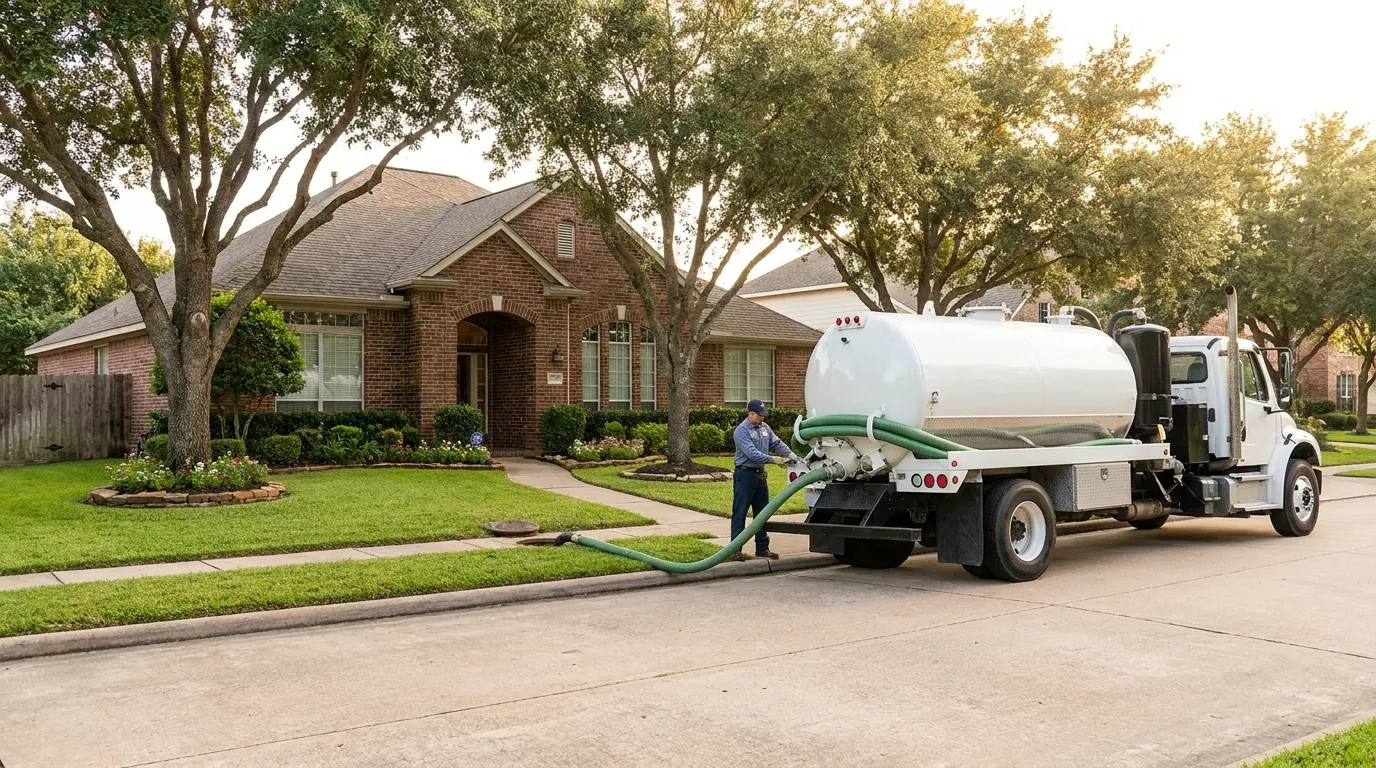
When your tank needs pumping
Every septic tank fills. Solids settle to the bottom as sludge, grease and lighter material float as a scum layer, and the clear liquid in the middle flows out to the drain field. Pumping removes those solid layers before they build high enough to escape toward the field. Skip it long enough and you trade an affordable pump-out for a far larger drain field repair.
In League City, the expansive clay soils that surround most tanks drain slowly, so a tank that is falling behind shows itself quickly — slow drains, gurgling toilets, or a whiff of sewage near the tank lid after a wet spell. If you are seeing any of that, a septic tank pumping service is usually the first and cheapest thing to rule out.
Not sure whether pumping is enough? A septic system inspection tells you whether the problem stops at the tank or reaches the drain field.
What septic tank pumping involves
A straightforward pump-out follows the same basic sequence at nearly every home.
-
Locate and uncover the access lid
We find the tank and expose its access risers or lids. Many League City tanks are buried under a few inches of clay and turf; if there is no riser, the lid has to be dug out by hand before work can start.
-
Measure the sludge and scum
Before pumping, we check how deep the sludge and scum layers have grown. This tells us how overdue the tank was and helps estimate a realistic pumping interval for your household.
-
Pump both compartments
A vacuum hose removes the full contents of the tank — liquid, scum, and sludge — from every compartment. Most modern tanks have two chambers, and both must be emptied to reset the system.
-
Inspect the interior
With the tank empty, we look at the inlet and outlet baffles, the tank walls, and the effluent filter if one is present. Cracked baffles or a missing filter are common findings and worth addressing while the tank is open.
-
Backfill and note the next interval
We reseat the lid, backfill, and give you a suggested date for the next service based on tank size and how full it was this time.
How local soil and weather change the job
League City sits on heavy Gulf Coast clay with a naturally high water table, and both work against a septic system. Clay percolates slowly, so effluent leaving the tank has less room to soak away than it would in sandy soil. When a tank gets overloaded with solids on top of that, the field has no margin to absorb the extra load.
The region's sudden storms make it worse. After heavy rain, the ground around the drain field saturates and the water table rises, sometimes above the field itself. A tank that was borderline before the storm can back up during it. That is why we look closely at how full the tank is relative to how much rain the yard has taken recently.
For homes that flood or sit low, pumping slightly more often is a reasonable insurance policy. We measure the layers each visit so your interval reflects your actual usage and site, not a generic rule of thumb. If the storm connection is a concern for you, see our notes on septic care during heavy rain.
Ready to schedule a pump-out?
Tell us your tank size if you know it and roughly when it was last pumped, and we will get you on the schedule.
Call to arrange septic tank pumping in League City and nearby towns.
Frequently asked questions
How much does septic tank pumping cost in League City?
Cost depends mostly on tank size, how overdue the tank is, and how hard the lid is to reach. A standard, on-schedule pump-out costs less than one where hardened sludge has to be broken up first. We walk through the drivers in our article on septic tank pumping cost.
How do I know if I need pumping or a bigger repair?
Slow drains and odors often mean a full tank, but the same symptoms can point to a drain field problem. Pumping is the cheapest thing to rule out first, and measuring the sludge during the visit tells us whether the tank alone explains what you are seeing.
Do you pump both compartments of the tank?
Yes. Most modern tanks have two chambers, and emptying only the first leaves the system partly full and defeats the purpose. We pump every compartment through the proper access points.
Will you dig up the lid if there is no riser?
We can. Many older League City tanks have lids buried under several inches of clay and turf. If there is no riser installed, we uncover the lid by hand before pumping, and we can talk about adding a riser to make future service easier.