Septic Tank Cleaning in League City, TX
Septic tank cleaning in League City, TX. We remove compacted sludge and hardened scum a quick pump leaves behind, then inspect and reset your schedule.
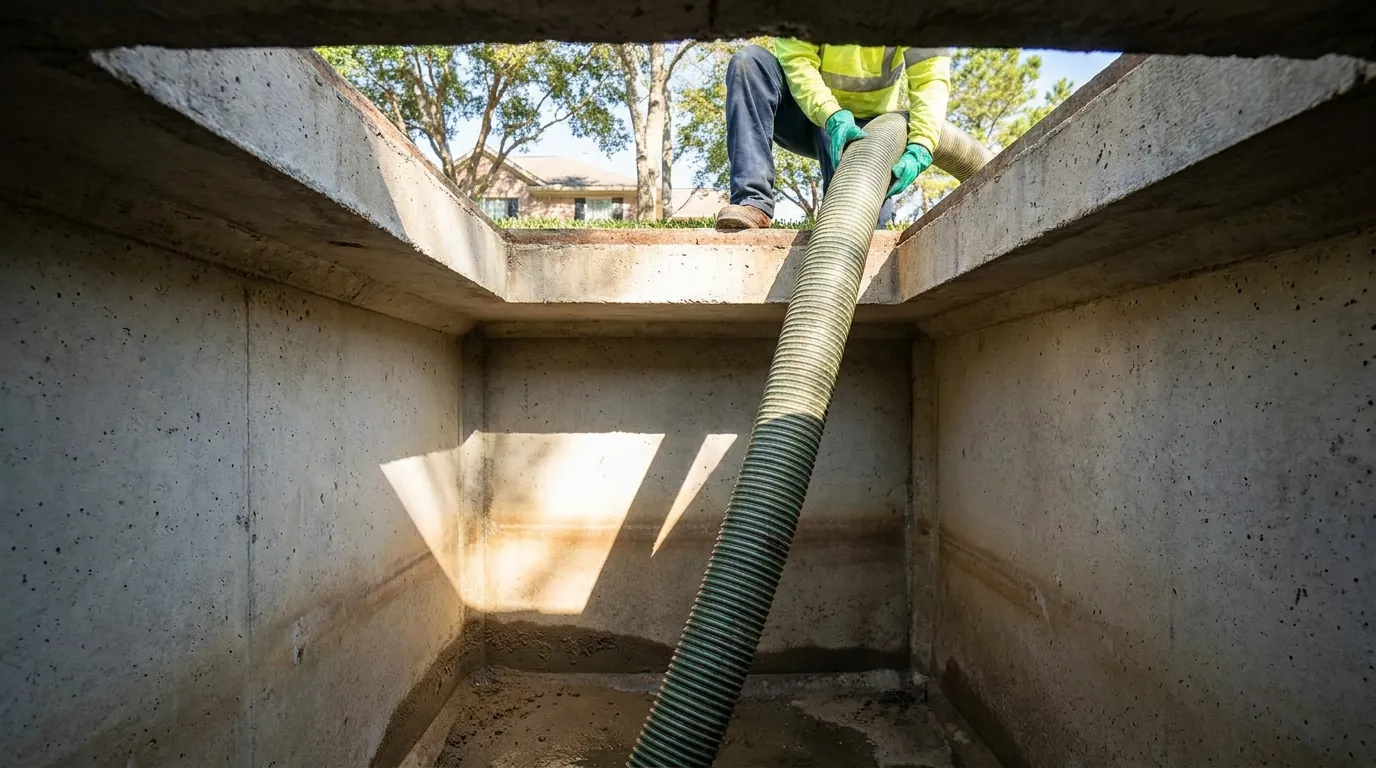
Cleaning versus a quick pump-out
A routine pump removes the liquid and loose solids. Cleaning a septic tank goes further: it breaks up and hauls out the dense sludge compacted on the tank floor and the hardened scum crust near the top — the material a fast pump-out leaves behind. Over years those layers cement in place, and a tank that gets only a surface pump keeps losing capacity even though it was serviced.
Cleaning the septic tank makes the most sense when a tank has gone a long time between services, when a new homeowner inherits an unknown history, or when repeated backups suggest the tank never really got emptied. If your drains stayed sluggish after a recent pumping, a proper cleaning is often what was missing.
Cleaning also pairs naturally with a septic system inspection, because an empty, rinsed tank is the easiest time to spot cracks and worn baffles. If buildup keeps returning fast, the cause may lie downstream in the drain field.
How septic tank cleaning works
Cleaning builds on the pump-out with extra steps to clear stubborn buildup.
-
Full pump-down
We first remove all liquid and loose solids so the tank is empty enough to work in and inspect.
-
Break up and remove sludge
We agitate and draw out the dense sludge that has compacted on the tank floor — the material a quick pump often leaves behind.
-
Clear the scum crust
The hardened scum layer near the top gets broken up and removed so the inlet and outlet baffles are no longer obstructed.
-
Rinse and inspect
We rinse the interior and check the baffles, walls, and effluent filter. A cleaned tank makes cracks and worn baffles far easier to spot.
-
Confirm flow and reset schedule
With the tank clean, we confirm the inlet and outlet are clear and give you a maintenance interval to keep buildup from returning.
Why League City tanks need it
The clay soils around League City slow the whole system down, which lets solids settle and compact more thoroughly than they would in a fast-draining site. A tank that spends years on the edge of overdue tends to develop a hard sludge layer that a routine pump can't lift — exactly the situation cleaning is for.
The area's warm climate speeds bacterial activity but also thickens the scum layer as grease accumulates near the surface. Combined with the slow-percolating ground, that crust can grow tall enough to block the outlet baffle, sending scum toward the drain field. Clearing it protects the field, which is the most expensive part of the system to replace.
After a thorough cleaning we set a realistic interval so the tank doesn't drift back into the same overloaded state. For most households that is a regular pumping schedule; for homes with heavy use or a high-water-table lot, slightly more often.
Schedule a thorough tank cleaning
If your tank has gone a long time between services or backs up after pumping, a full cleaning resets it properly.
Call to arrange septic tank cleaning in League City and nearby towns.
Frequently asked questions
What's the difference between pumping and cleaning a septic tank?
Pumping removes liquid and loose solids. Cleaning additionally breaks up and hauls out the compacted sludge on the floor and the hardened scum crust on top, then rinses and inspects the interior. Cleaning restores more of the tank's original capacity.
How often does a tank actually need a full cleaning?
Not every service needs the deep clean — many households are fine with routine pumping on schedule. A full cleaning makes sense when a tank has gone years without service, has an unknown history, or keeps backing up after being pumped.
Will cleaning fix my slow drains?
If the sluggishness comes from a tank clogged with compacted solids and a blocked outlet baffle, cleaning usually resolves it. If the drain field is the bottleneck, cleaning helps but the field itself may need attention.
Can you clean and inspect in the same visit?
Yes, and that is the efficient way to do it. An empty, rinsed tank is the clearest moment to check baffles, filters, and walls for damage, so we look while the tank is open.